The platform
What does an AI governance platform do?
It lists every AI agent, limits what each may do, asks a person before risky actions, and proves what happened.
- Mid-market B2B
- Early access
- Today and Roadmap labeled
Why now
AI now acts, not just answers
A wrong answer can be ignored. A wrong action reaches a customer.
Sends email
To your customers
Updates records
In your systems
Commits spend
Against a budget
82%
40%+
How it works
Four steps, one control layer
A person decides what matters
- Low risk runs by itself
- High risk waits for a person
- Prohibited is blocked
The path
Every action takes the same route
- 1Agent proposes an actionFor example, send a follow-up email.
- 2Policy decidesChecks the agent's limits, risk and budget.
- 3Run, ask or blockLow risk runs. High risk waits for a named approver. Prohibited is blocked.
- 4RecordedWho, what, when, approver and cost go on the record.
- Low risk: it runs
- High risk: a person decides
- Prohibited: blocked
In the product
One interface for the whole loop
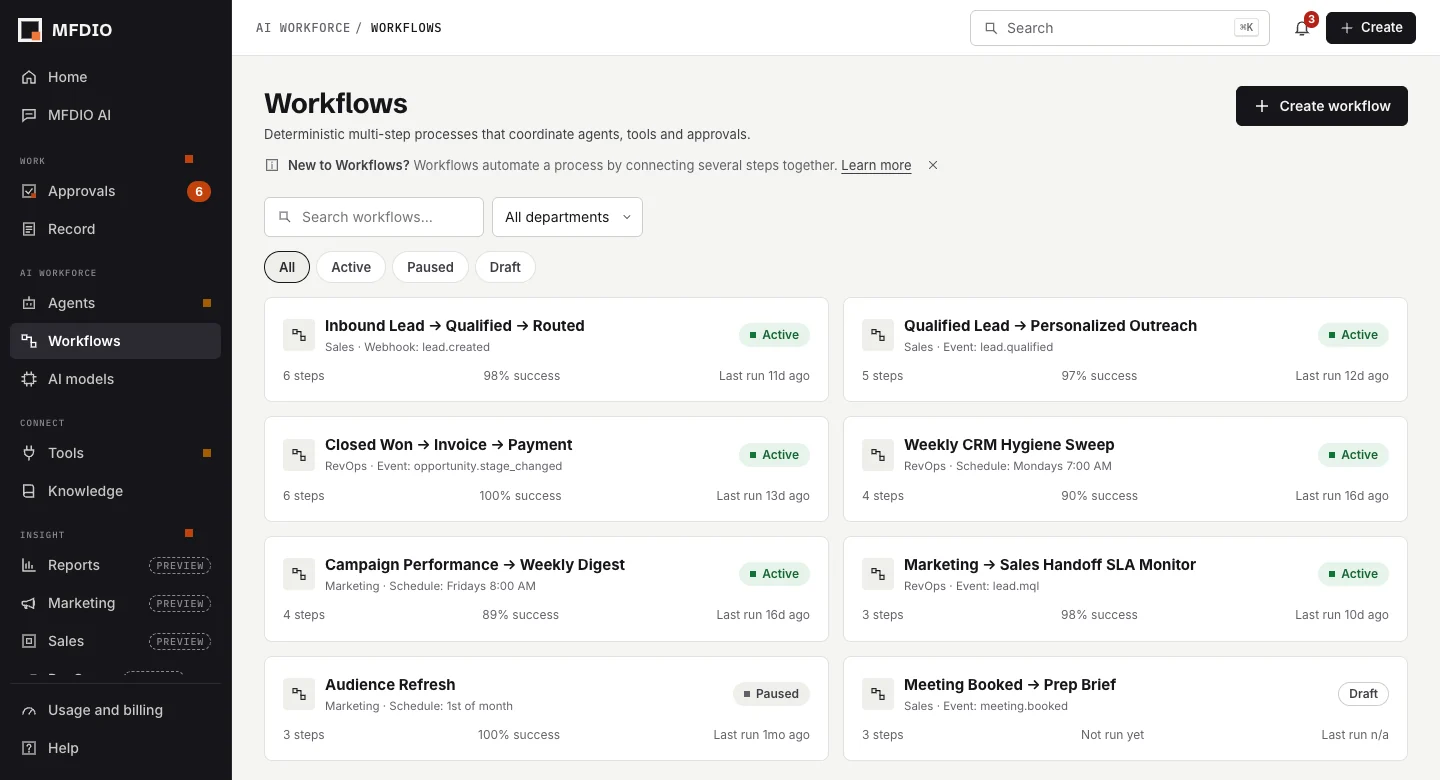
- Workflows that include approval steps
- Approvals in their own queue
- The record of every run
The difference
Governance, not automation
AutomationMFDIO
GoalAutomation: Make AI do moreMFDIO: Make AI safe to trust with more
ApprovalAutomation: Added later, or neverMFDIO: Built in from day one
ProofAutomation: "Trust us"MFDIO: A record of every action
PeopleAutomation: Left out once it runsMFDIO: Decide what matters
Honest status
What works today
Today Works now
- AI assistant in the workspace
- Agents and workflows with approvals
- Any tool that speaks MCP
- Audit log, roles, invitations
- Spend limits in Work Units
Roadmap Planned
- One-click CRM, email and chat connections
- Agents built elsewhere in the register
- Choosing a model per job
- SOC 2 and ISO 27001
Quick answers
Is MFDIO an automation tool?
No. Automation makes AI do more. MFDIO makes AI safe to trust with more.
Does it replace our tools?
No. Existing systems are kept. Any tool that speaks MCP can be connected today.
Does the AI act on its own?
Only where policy allows it. Risky actions wait for a named approver first.